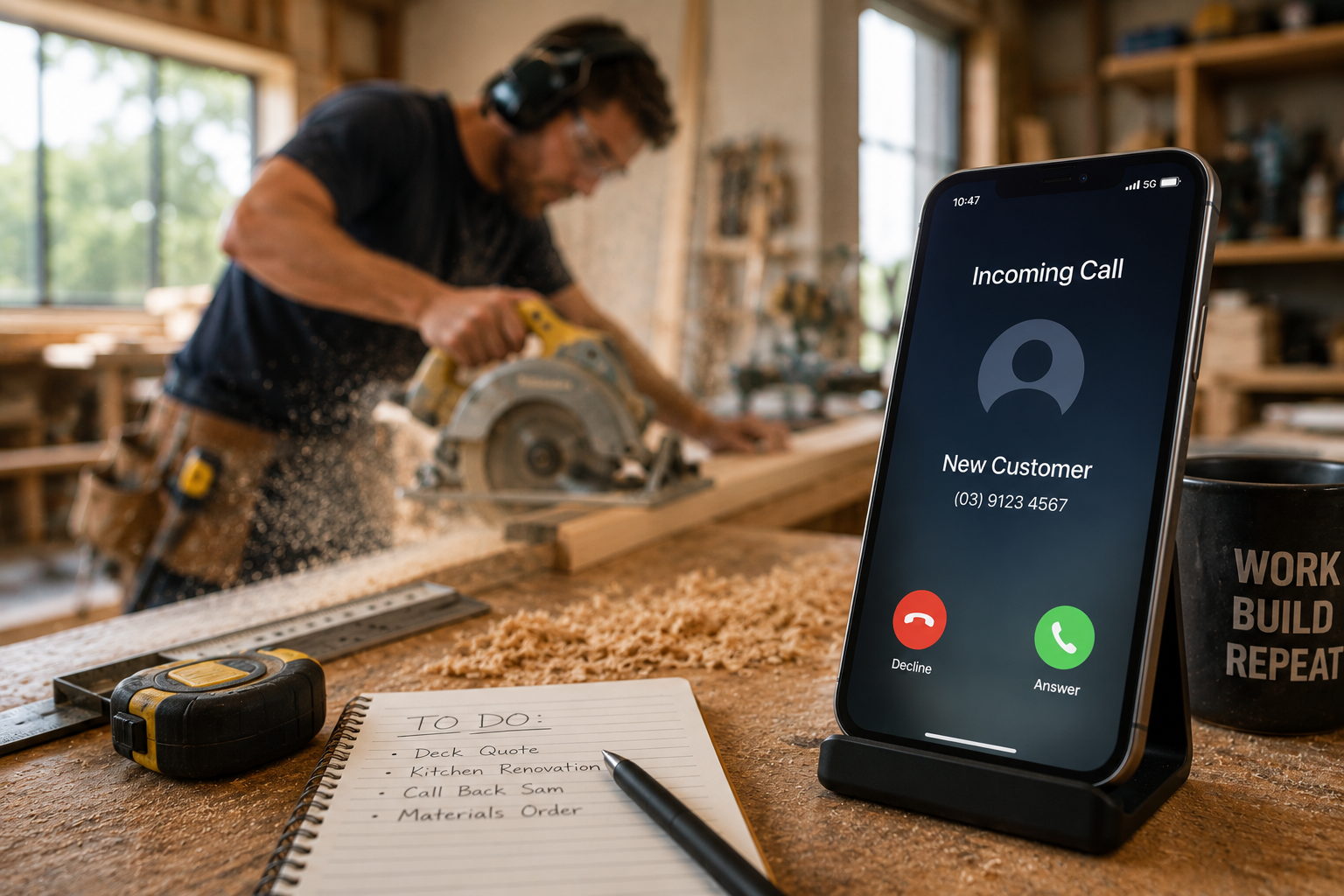

For many U.S. home-service businesses, the phone is still where business begins. A homeowner calls because their air conditioner stopped working. A property manager needs an electrician. A customer has a leaking pipe and wants to know how quickly a plumber can get there. Someone else is calling for an estimate on a new installation.
Every one of these calls represents a potential job, but there's a problem: the people who know the business best are often the people least able to answer the phone.
Contractors and technicians are on job sites, driving between appointments, working with customers, or handling equipment. Office teams are managing schedules, dispatch, and paperwork. When things get busy, calls get missed, voicemails pile up, and quote requests sit waiting for someone to call back.
Voice-to-quote technology offers a different approach.
By combining AI-powered phone answering with structured customer intake and quoting workflows, home-service businesses can turn an incoming phone conversation into a detailed quote request without requiring someone to manually handle every initial call.
The basic idea is simple:
Customer calls → AI answers → details are captured → job is qualified → draft quote or next step is prepared → your team reviews and approves.
The Phone Is Still Where Many Jobs Begin
For many home-service customers, filling out a long online form isn't the first thing they want to do when something goes wrong.
They want to call someone.
If water is leaking through the ceiling, they're probably calling a plumber. If the AC stops cooling during a hot summer afternoon, they're looking for an HVAC company. If part of the house suddenly loses power, an electrician may be their first call.
The phone gives customers a fast and familiar way to explain what's happening.
The challenge is making sure somebody — or something — is available to answer.
For home-service businesses, AI voice technology creates an opportunity to address a very practical problem: turning more incoming calls into structured job opportunities without requiring an employee to stop what they're doing every time the phone rings.
From a Missed Call to a Structured Job
A traditional missed call doesn't tell you much.
You might receive a voicemail saying:
"My AC isn't working. Can someone call me back?"
Someone from the business then has to return the call and start collecting information.
What's the customer's name?
What's the service address?
What type of system do they have?
What's happening with it?
When did the problem start?
How urgent is it?
When is the customer available?
A voice-to-quote workflow moves much of that information gathering into the initial call.
Instead of simply recording a message, an AI voice system can conduct the initial conversation and collect information based on the type of service the customer needs.
A plumbing company might ask about the location and severity of a leak.
An HVAC company might ask about the type of system and symptoms.
An electrical contractor might need to know whether the issue affects the entire property or only a specific room or circuit.
The information collected during the conversation can then be organized into a structured job request.
Instead of:
"Customer called about an AC problem."
Your team could receive:
"Residential customer. Central AC is running but not cooling. Problem started this morning. Service address and contact details captured. Customer is available this afternoon."
Now your team starts with context instead of another round of phone tag.
Turning Voice Into a Quote
Capturing information is only the first step.
The bigger opportunity is using that information to speed up the quoting process.
Many home-service businesses already have standard pricing for certain types of work. There may be service-call fees, diagnostic fees, maintenance packages, standard installations, or other predefined services.
When an incoming request clearly matches one of these predefined services, information captured during the call can be used to help prepare a draft quote based on the business's approved pricing and rules.
The important word is draft.
The business remains in control of the final price.
The AI gathers the information and helps prepare the next step. Your team can review the details, make any necessary adjustments, approve the quote, and send it to the customer.
Two Ways Voice-to-Quote Can Work
Not every service call should be quoted the same way.
There are generally two useful approaches.
1. Draft Quotes for Straightforward Jobs
Some services are relatively predictable.
If your business already has approved pricing for a particular service, the information gathered during the call can potentially be matched with those existing pricing rules.
The system can then help prepare a draft quote for your team.
A team member reviews it.
If everything looks right, they approve it and send it.
This can remove much of the repetitive administrative work involved in preparing routine quotes while keeping a human in control of what actually reaches the customer.
2. Qualify Complex Jobs Before Quoting
Other jobs simply can't be priced accurately from a phone call.
Replacing an HVAC system, rewiring a property, repiping a house, or completing a large commercial project may require an inspection, measurements, equipment specifications, or professional judgment.
In those situations, AI shouldn't invent a price.
Instead, the call can be used to gather the information needed to determine what should happen next.
The customer might need an on-site estimate.
The project might need to be reviewed by an estimator.
Additional photos or specifications might be required.
The goal isn't to automate every quote.
It's to automate the path to the right quoting process.
Quote the Simple Jobs. Qualify the Complex Ones.
Imagine two customers calling an HVAC company.
The first customer wants routine seasonal maintenance.
The second wants to replace an aging HVAC system in a large home.
Those calls shouldn't follow exactly the same workflow.
The maintenance request may fit an existing service and pricing structure. The replacement probably requires an assessment before an accurate estimate can be prepared.
Voice-to-quote can help distinguish between the two.
Straightforward requests can move toward approved pricing and a draft quote.
More complex opportunities can be qualified and passed to the appropriate person with the important information already captured.
The same principle applies to plumbing, electrical, roofing, landscaping, and other home-service businesses.
Automate what can be standardized. Collect better information for everything else.
Why the Phone Call Is the Hard Part
Creating a quote isn't necessarily the hardest part of the process.
Getting accurate information from the customer often is.
Customers don't describe problems using the terminology your business uses internally.
A homeowner doesn't necessarily say:
"My 4-ton split-system air conditioner appears to have a refrigerant-related cooling issue."
They say:
"The AC is running, but the house is still hot."
A plumbing customer might say:
"There's water everywhere under the sink."
An electrician might hear:
"Half the outlets upstairs stopped working."
Before those statements can become useful job information, somebody has to ask the right follow-up questions.
That's why the conversation matters.
A useful voice-to-quote system isn't simply transcribing what the customer says. It needs to gather the specific information your business requires to understand the request and determine the appropriate next step.
That's where much of the value comes from.
Faster Quotes Can Mean Faster Decisions
Customers often contact more than one company when they need service.
If a homeowner calls three HVAC companies and only one answers immediately, understands the problem, gathers the necessary information, and clearly explains the next step, that company has already created a smoother customer experience.
Voice-to-quote doesn't remove the need for accurate pricing or professional judgment.
It can reduce the time between:
"Can I get an estimate?"
and
"Here's what happens next."
Instead of:
Call → missed call → voicemail → callback → questions → notes → quote
the workflow can become:
Call → AI conversation → structured information → qualification → draft quote or assessment → human approval
That can remove unnecessary back-and-forth from the process.
From Quote to Booking
Quoting is only part of the customer journey.
Once a customer is ready to move forward, the next step might be scheduling a service call, consultation, inspection, or installation.
Voice-to-quote can help prepare the information needed for that handoff.
Vocatus doesn't need to replace the scheduling, dispatch, CRM, or field-service management systems your company already uses.
Instead, the goal is to improve what happens before those systems take over.
The customer conversation is handled.
The important information is captured.
The request is qualified.
Then your team has better information to continue the job through its existing operational workflow.
Any connection to third-party platforms depends on the systems and integrations configured for the individual business.
One Conversation. A Better Handoff.
Imagine a homeowner calling a plumbing company because their water heater stopped working.
The AI answers and lets the customer explain what's happening.
It asks relevant follow-up questions.
The customer's name, phone number, and service address are captured.
The system gathers details about the water heater and the problem they're experiencing.
The request is categorized.
If it's a straightforward service covered by predefined business rules, the information can help prepare the appropriate next step.
If an assessment is required, the request can be passed to the team with the important details already collected.
The plumber or office team isn't starting from:
"Someone called about their water heater."
They're starting with an organized service request.
That's a much better handoff.
Less Time Chasing Missed Calls
Returning missed calls can become a job by itself.
A contractor finishes a long day and sees eight missed calls.
They start calling people back.
Two don't answer.
One already hired another company.
Another needs a service the business doesn't provide.
Another lives outside the service area.
An hour disappears before a single estimate has been prepared.
With AI handling initial call intake, your team can start with better information.
Who is the customer?
What do they need?
Where are they located?
How urgent is the problem?
Is the job a good fit?
Does it need a quote, inspection, service appointment, or human review?
Instead of starting every conversation from zero, your team starts with context.
After-Hours Calls Become Opportunities
Home-service problems don't follow a 9-to-5 schedule.
A pipe can burst at 11:30 PM.
An AC system can stop cooling on Sunday afternoon.
A homeowner might finally remember to call an electrician after getting home from work.
Traditionally, those calls may go to voicemail or an answering service.
AI-powered call intake provides another option.
The customer can explain the problem, provide their information, and have the request structured for the appropriate next step.
Depending on the business's rules, emergency requests can follow a different workflow from routine calls.
Your team can determine how different situations should be handled.
How Vocatus Can Help
Vocatus helps home-service businesses build a smarter front office around one of their most important customer touchpoints: the phone call.
Instead of every unanswered call turning into another voicemail, AI-powered voice technology can handle the initial conversation and collect the information your team needs to move the request forward.
For plumbing, HVAC, electrical, and other home-service businesses, that means turning an unstructured phone conversation into something the team can actually work with.
Vocatus can help capture why the customer is calling, gather relevant customer and service details, and guide the request toward the appropriate next step based on the business's configured workflows.
Straightforward services can move toward approved quoting processes.
Complex jobs can be qualified and handed to the team for review.
And importantly, Vocatus doesn't replace your dispatch board or field-service management platform. Instead, it helps make sure your team receives qualified opportunities with the important customer and service details already captured.
The goal isn't to replace the contractor, technician, dispatcher, or estimator.
It's to reduce the administrative gap between a customer calling for help and your team having enough information to act.
From "Can I Get an Estimate?" to the Next Step
For U.S. home-service businesses, the phone isn't going away.
Customers will continue calling plumbers when pipes leak, HVAC companies when their homes won't cool, and electricians when something stops working.
What's changing is what can happen after the phone rings.
Instead of:
Ring → missed call → voicemail → callback → questions → notes → quote
you can build a workflow closer to:
Ring → answer → understand → qualify → draft → approve → send
Voice-to-quote isn't about letting AI run your home-service business.
It's about helping your team capture better information, respond faster, and spend less time chasing the details needed to prepare a quote.
With Vocatus, the journey from "Can I get an estimate?" to "Here's what happens next" can become faster, simpler, and more structured — while your team stays in control.