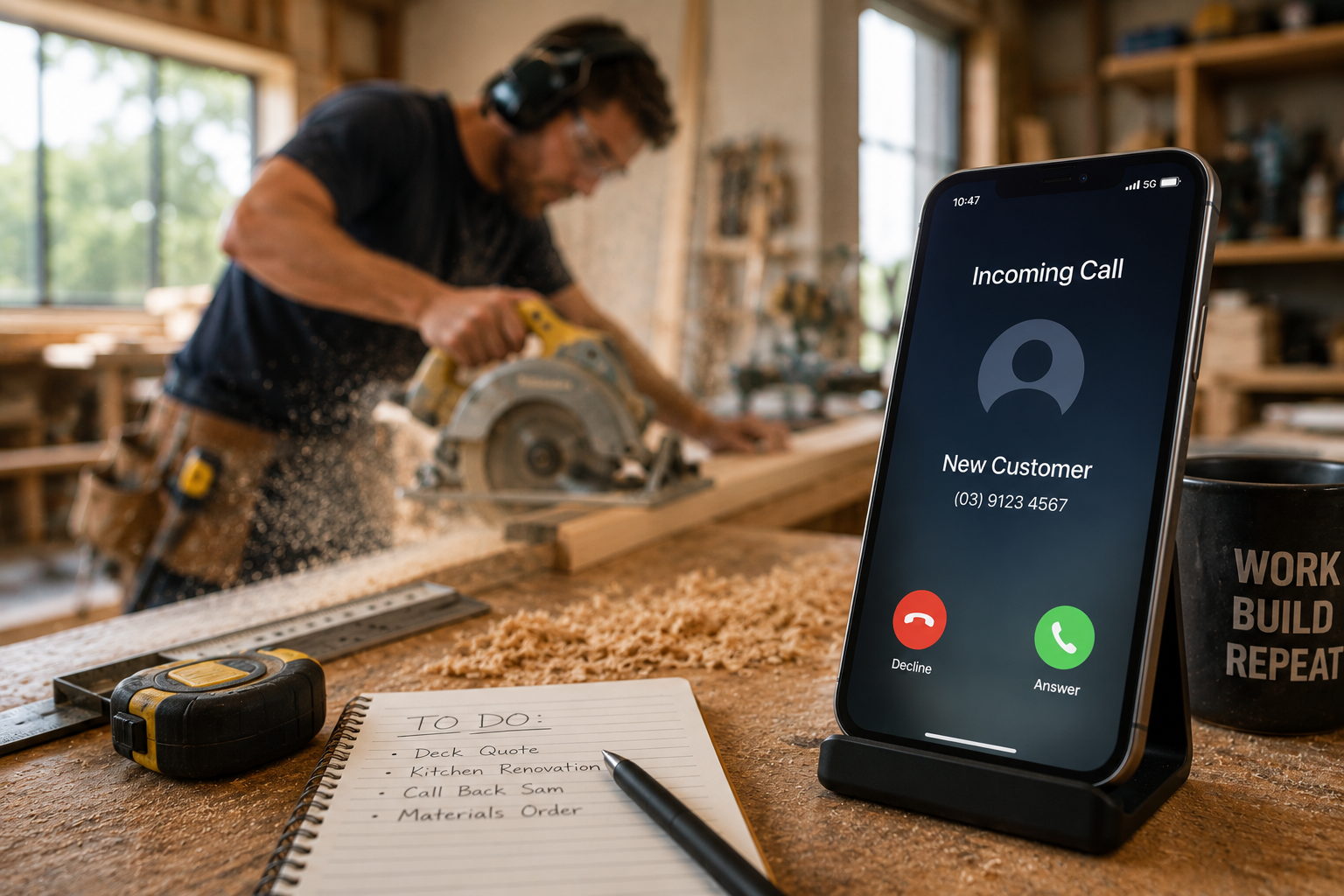

AI Receptionists for Carpenters: Qualify Better Leads and Book the Right Jobs
For carpenters, not every phone call is a good opportunity. One homeowner might be looking for a custom deck worth thousands of dollars, another may need built-in cabinetry or a major renovation, while the next caller just wants someone to repair a loose cabinet hinge across town.
When you're already working on a jobsite, every phone call pulls your attention away from the work in front of you. And spending your evenings returning calls for projects you don't take can be almost as frustrating as missing a valuable lead.
For many carpentry businesses, the challenge isn't simply generating more leads. It's figuring out which leads actually fit your business.
An AI receptionist can help by answering incoming calls, collecting project information, qualifying inquiries according to your business rules, and helping suitable customers move toward the appropriate next step.
Not Every Lead Is the Right Lead
Growing a carpentry business doesn't necessarily mean saying yes to every project.
A carpenter specializing in custom cabinetry may not want to drive across town for a minor door repair. A contractor focused on decks and outdoor structures may not handle furniture restoration. A commercial carpentry company may have little interest in small residential repairs.
The problem is that you often don't know whether a project is a good fit until you've already spent time talking to the customer.
Someone calls while you're working, so you miss it. You return the call later, but they don't answer. Eventually you connect, spend ten minutes discussing the project, and discover it's outside your service area or isn't a service you provide.
Repeat that several times a week and lead qualification becomes a significant administrative task.
An AI receptionist can move some of that work to the beginning of the customer journey.
Turn “I Need a Carpenter” Into a Useful Project Inquiry
“I need a carpenter” doesn't tell you very much.
The customer might need a deck, custom cabinets, framing, flooring, doors, built-ins, a home renovation, or a small repair.
Before deciding whether the project is worth pursuing, you need more information.
An AI receptionist can collect details such as:
- Customer name and contact information
- Project location
- Type of carpentry work
- Approximate scope
- Desired timeline
- Relevant project requirements
- Other information your business uses to evaluate new work
Suppose someone calls and says:
“I'm looking for someone to build a deck in my backyard.”
Instead of leaving your team with that single sentence, the AI receptionist can ask relevant follow-up questions based on the intake process you've configured.
When you review the inquiry, you're starting with useful project information instead of a vague voicemail.
Set Your Own Qualification Rules
Every carpentry business operates differently.
Some contractors want large remodeling projects. Others specialize in decks. Some focus on cabinetry and built-ins, while others primarily work with builders or commercial clients.
Your intake process should reflect the business you actually operate.
You might have a defined service area. You may only accept certain types of projects. You might want larger remodeling or commercial opportunities prioritized for review.
Vocatus can use the workflows and information you configure to help guide the initial conversation and determine an appropriate next step.
The important distinction is that you define the criteria.
AI helps collect and organize information consistently; it doesn't independently decide which projects your business should accept.
Spend Your Time on Projects Worth Quoting
Preparing an accurate carpentry estimate can take considerable time.
Larger projects may require reviewing plans, visiting the property, taking measurements, calculating materials and labor, speaking with suppliers, and preparing a detailed proposal.
That work makes sense for a serious opportunity. It makes much less sense when the project was never a good fit in the first place.
That's why qualification should happen before significant time is spent estimating.
An AI receptionist can gather preliminary project information so your team has more context when deciding whether an inquiry deserves further attention.
For straightforward requests, the customer can be directed toward your configured next step. For larger or more complicated projects, the information collected during the call can help your team decide whether to schedule a consultation or site visit.
The carpenter remains responsible for evaluating the project and preparing the final estimate.
Move Good Leads Forward Faster
Finding a promising lead is only part of the process. You also need to respond before the homeowner hires someone else.
A homeowner planning a remodel or new deck may contact several contractors. If your company takes two days to respond while another carpenter answers immediately and arranges a consultation, you're already at a disadvantage.
An AI receptionist can help shorten the gap between the customer's first call and your response.
Once the initial information has been collected, the inquiry can follow the workflow you've configured—whether that's requesting an appointment, arranging a consultation, sending the information to your team for review, or another appropriate next step.
Vocatus focuses on the call-handling and customer-intake stage. Your existing business systems and team can continue handling estimating, project management, dispatching, invoicing, and other operational processes.
Any connections to third-party platforms depend on the specific tools and integrations configured for your business.
Handle Poor-Fit Inquiries More Efficiently
Saying no to work is part of running a carpentry business.
A project might be outside your service area, too small for your current business model, outside your specialty, or needed sooner than your schedule allows.
Not every inquiry needs to become a lengthy callback.
With properly configured workflows, an AI receptionist can collect the necessary information and help identify situations that don't match your basic service criteria.
Depending on how you've configured the experience, the caller can receive an appropriate response or their information can be collected for your team to review.
The goal isn't to dismiss potential customers. It's to reduce unnecessary back-and-forth while giving callers a clear response.
Keep Working When the Phone Rings
For solo carpenters and small contracting teams, there often isn't a dedicated receptionist sitting in an office.
The carpenter may also be the estimator, salesperson, project manager, scheduler, and person expected to answer the phone.
That's difficult when you're measuring lumber, installing cabinetry, operating equipment, or working on a jobsite.
An AI receptionist can serve as the first point of contact while you stay focused on your work.
Instead of interrupting a project every time the phone rings, you can review organized inquiries when you're available and prioritize the ones that deserve your attention.
Capture After-Hours Inquiries
Customers don't only think about home improvement projects between 9 and 5.
Someone might research a kitchen remodel after dinner, discuss a new deck with their spouse over the weekend, or finally call about custom cabinetry after getting home from work.
If they reach voicemail, they may leave a message—or they may call another contractor.
AI call handling can give customers an immediate first point of contact outside your normal business hours.
They can explain what they need and provide relevant project information. When your team returns, you have more than a list of missed calls. You have organized inquiries that are easier to review and prioritize.
Less Admin. More Carpentry.
Administrative work doesn't end when you leave the jobsite.
There are still calls to return, inquiries to review, estimates to prepare, appointments to coordinate, and potential customers to qualify.
AI isn't going to measure a room, build a deck, install cabinets, or replace the professional judgment required to estimate a complicated remodeling project.
What it can do is reduce some of the repetitive work that happens before your expertise is needed.
By the time an inquiry reaches you, you can already have useful information about what the customer needs.
That means less time repeatedly asking basic questions and more time evaluating serious opportunities.
How Vocatus AI Can Help Carpenters
Vocatus AI is designed to help service businesses improve the way incoming calls and customer inquiries are handled.
For carpentry businesses, that starts when a potential customer picks up the phone.
An AI receptionist can handle the initial conversation and collect relevant information about the project, such as what type of work the customer needs, where the project is located, its approximate scope, and other details your business uses during initial qualification.
From there, the inquiry can follow the workflow you've configured.
For a solo carpenter, this can mean fewer interruptions while working on a jobsite. For growing carpentry companies, it can create a more consistent process for handling a larger volume of calls. For office teams, it can reduce the amount of repetitive information gathering required for every new inquiry.
And for customers, it means they can get a response without waiting for someone to finish the current job and return their voicemail.
Vocatus doesn't decide what makes a project valuable to your business.
You set the rules. Vocatus helps handle the conversation and collect the information.
Focus on the Right Jobs
A busy phone doesn't necessarily mean a profitable carpentry business.
What matters is what those calls eventually become.
Ten inquiries for projects you don't handle can create hours of administrative work without generating meaningful revenue. One well-qualified inquiry for exactly the type of project your business specializes in may be far more valuable.
A smarter intake process helps you understand the opportunity earlier:
Customer calls → AI answers → Project details are collected → Inquiry is qualified → Your team reviews the opportunity → The right leads move forward
The goal isn't simply to answer more calls.
It's to help your carpentry business spend less time sorting through poor-fit inquiries and more time estimating, booking, and completing the projects that actually fit your business.